Coffee Is A Stimulant, Not An Alarm Clock

Coffee works best when used to help us get stuff done quicker. Waking up really isn’t one of them.

1_R1TKaXXWNAkKZul-ISV7gA


So, the alarm goes off, and you hit snooze. It goes off five minutes later and you hit snooze again. It rings a third time, but now you have to get up. You stumble out of bed, barely remembering who you are and head straight for the coffee maker — after any other necessities.

You finish the first cup, but barely notice any difference in your mood or alertness. The second cup comes and goes, and it seems to be getting better. But you still have trouble carrying a conversation. So, you go for your third and final cup with breakfast. That does the trick — after a  whole hour of being awake.

You probably know someone who doesn’t want to talk — and whom you don’t want to talk to — until they get their first cup of Joe. The problem, however, is that they are simply not a morning person, and the need for coffee is an excuse to act groggily. Notice, they’re never much better after they’ve had their first cup, or third.

Drinking coffee first thing in the morning is a bit of a habit for most Americans. Forty-four percent drink it with breakfast — myself included. But for those of us who drink it religiously, it helps to ask what we’re expecting it to do for us.

Continue reading…


The Battle That Made Francis Drake Spain’s Worst Nightmare

Loutherbourg-Spanish_Armada

Depending on one’s historical sympathies, Sir Francis Drake is one of history’s many characters who was either great or infamous. To the English, he was a daring, successful patriot. To the Spanish, however, he represented everything to hate about lawless, Protestant aggression and the rising sea power to the north.

Queen Elizabeth, I knighted him after he circumnavigated the globe—the first Englishman to do so. The Spanish, meanwhile, dubbed him El Draque, or “The Dragon,” for the brazen piracy he carried out on that trip and countless others.

Drake contributed more than anyone to the war in which England famously defeated the Armada in 1588. But mere patriotism and fear of Catholicism didn’t drive him to harass the Spanish. For Drake, it was personal. One battle drove him mad with vengeance and convinced him he could no longer trust or trade with the Spanish.

In 1568, Drake was a 28-year-old captain in a seven-vessel fleet led by his cousin John Hawkins. This was his second slave-trading voyage to the Spanish colonies. The crew had recently unloaded its cargo in Cartagena, and the ships were weighed down with gold, silver, and all types of jewels.

During Hawkins’s most recent voyage, he and his crew had been feted as heroes by court and countrymen alike. He had also made a 60 percent profit and become highly wealthy overnight. The haul he carried now promised to dwarf his previous journeys.

On the way back to England, however, a violent storm hit the fleet off the coast of Cuba and drove them into the coast of Florida, badly damaging Hawkins’s ship, the Jesus of LubeckRunning low on supplies and unsure if the Jesus of Lubeck would make it back to England, Hawkins decided to risk landing at the nearest port, San Juan de Ulua, off Veracruz.

This created considerable concern because the English were trading with Spanish colonists on the black market. Spain’s King Phillip II interpreted the Treaty of Tordesillas—which divided the world between the Spanish and Portuguese—to mean that no other nation should colonize or trade in the Americas.

Three years earlier, the Spanish had massacred a French Huguenot colony near present-day Jacksonville, Florida for being there and being Protestant.

Continue reading…

No, Your Kid Can’t Be Whatever He Wants When He Grows Up

1_wz6a_poeRgihGILEzVtu1w

One of the saddest facts of American society is the unrealistic expectations American parents, for decades, have set for their children. Much of this stems from their living vicariously through their kids.

You know, the “Johnny, you can be whatever you want when you grow up if you put your mind to it.”

Or, “In America, if you can dream it, you can do it.”

Although the United States indeed offers more opportunities than most countries, it’s important to be realistic.

If a child has parents under six feet, his likelihood of becoming a professional basketball player is diminished. It’s not impossible but is highly unlikely.

But physical handicaps alone don’t determine a person’s career limitations. Even in America, who a child’s parents are and what they do matters career-wise. If you’re a waiter, and your spouse is a mechanic, your kid is probably not going to become a doctor, lawyer, or a professor.

We all know the inspirational stories of people raised in poverty who went on to make millions. But that’s not the norm, and if you look at the exceptions, these millionaires or successful professionals didn’t come upon their millions or professions by setting out from an early age to succeed.

They often started out doing something similar to what their parents did. They then used their instinctive know-how, work ethic, and practical sense their hardworking parents taught them to start businesses, make wise investments, or achieve professional success later in life — often at the expense of their health and relationships.

Continue reading…

Google IT Certificate Program: Post-Secondary Education Of The Future?

1_XFFtzWZOy3x5eym1A2kctw

Google’s certificate programs that it offers at community colleges provide a snapshot of how future corporate-academic cooperation could better match college curricula with needed job skills.

Despite the stock market’s doing well and low unemployment, Millennials are still underperforming relative to previous generations, despite being better educated. No other generation in history has wasted more money and time taking college courses and learning skills that do not translate into earnings.

This owes largely to the fact that universities aren’t teaching students the skills that companies want.

For decades, colleges did their thing, companies did their thing, and students did their thing (made good grades, graduated, got jobs, and moved up the corporate ladder). Before the internet, it mostly worked out because the skills companies demanded in employees didn’t change much from decade to decade.

But unless a student is planning to become a professor, universities are training students to work for otheremployers in an internet world with changing technological demands. Why should universities, taxpayers, and future employees have to foot the entire bill for training conglomerates’ future workers? Corporations too should have some skin in the game in preparing their next generation of employees.

Continue reading…

Why Was England Late To Colonize?

Canonniere

No nation ever dominated global trade and geopolitics more than Great Britain from the mid 18th century until World War I. But the English, who united with the Scots to form Britain in 1707, arrived late to the scene of colonization. The Age of Discovery—when Western Europeans explored Africa, Asia, and the Americas—began in the early 15th century. The English, however, didn’t establish any permanent colonies until the early 17th century.

The English lawyer John Rastell lamented this development, in the 1510s, in a play he wrote about a failed expedition he took part in toward America. “Oh, what a thing,” he wrote, if “they that be Englishmen” had been the first to “take possession” and “make the first building and habitation” in the New World.

So, what delayed the people who soon created the greatest empire the world has ever known?

Why did they sit back on their island and watch Spain conquer the most advanced peoples in the Americas and take South America’s riches for itself?

Why did they allow the Portuguese to gain the initial footholds in Africa and Asia and only much later wrest some of these regions from them?

To answer these questions, let’s first look at where the English were in their civilizational development when this exploration and colonization began.

Continue reading…

The Iran deal isn’t perfect, but it beats war

Iran_nuclear_program_map-en

As the October 15 deadline approaches for President Donald Trump to inform Congress if he will recertify the nuclear deal with Iran, the Joint Comprehensive Plan of Action (JCPOA), his final decision presents an opportunity for him to chart his own course in Republican foreign policy—one that puts Americans’ interests above the interests of their Middle Eastern allies who consider Iran their greatest geopolitical threat.

Congress passed the Iran Nuclear Agreement Review Act (INARA) right after the JCPOA, requiring the president to inform Congress every three months if Iran is complying with the nuclear deal. If the president finds that Iran is not complying, the United States doesn’t automatically exit the deal, rather, Congress then has 60 days to decide whether to reimpose economic sanctions on the country.

During the presidential campaign, Trump often criticized the JCPOA as “an embarrassment to our country,” saying Obama should have treated the release of American prisoners in Iran as a prerequisite for any deal, and claiming Obama gave Iran the impression that it would not walk away from the negotiating table regardless of the outcome.

Trump told the Wall Street Journal in July, “If it was up to me, I would have had [the Iranians] noncompliant 180 days ago.” Then, in his speech before the United Nations on September 19, he blasted the Iranian government for masking its corrupt dictatorship, funding terrorists, “undermining peace throughout the Middle East,” and “building dangerous missiles.”

But Iran’s missile program can’t reach the U.S. Furthermore, even if it could, without nuclear warheads it would be completely impotent against the superior conventional militaries of Israel and the U.S.—not to mention the U.S. nuclear arsenal. In addition, Iran’s missiles don’t factor into the deal.

Nikki Haley, U.S. Ambassador to the United Nations, has also expressed outright hostility toward the deal and the nation of Iran itself. In a speech to the American Enterprise Institute (AEI) on September 5, she insisted that Iran has violated the deal. But the only two examples she could give were when Iran briefly exceeded its suggested limit of heavy water twice in 2016.

Continue reading

Personal Experience with Amtrak

I recently rode Amtrak for the first time, and I must admit that the United States can do better in the area of rail travel.

Raised in a fairly nostalgic home environment, my childhood VHS entertainment featured a steady stream of old films like Young Tom Edison, Where the Red Fern Grows, North by Northwest, and of course a pile of Westerns based on eras when trains were the form of public transportation.

Some of the best action movies in history have, in fact, involved suspenseful train scenes. Think of the Mission Impossible series, Money Train, From Russia with Love, and Skyfall.

Trains have always represented adventure, suspense, and independence in my mind.

My desire to travel by train as a kid went largely unfulfilled, though, as passenger train service had essentially died in the southern U.S. three decades before I was born.

Image from bootsnall.com

Before giving my full experience on America’s passenger train monopoly, though, I must admit that European rail had spoiled my expectations. I’ve traveled on nearly every form of European train, from sleeper cars, to German first class, to ex-communist-bloc clunkers with no plumbing (See image to the right). So, I fully expected that Amtrak wouldn’t come near Western European standards.

After my last Greyhound bus experience, which included a ten-hour delay because of a station shooting in Richmond, having to pay $160 in Nashville (more than my entire round-trip ticket) to retrieve my truck after the employees impounded it (Greyhound’s website contained no warning that parking was not available at the station), I had promised myself never again to pay a cent to that poorly-run, antiquated hound .

Moving to Washington, DC, I was unwilling to pay the extra airfare for all the luggage and the bicycle that I was taking.

So, willing to hitchhike from Birmingham to Washington, D.C. before resorting to Greyhound, I decided to check Amtrak prices.

The price wasn’t bad, $160 one-way with two free suitcases with an extra $20 for the third. Taking along bikes are free with Amtrak, which was the deal-seller since the much cheaper Megabus does not have room for them.

I arrived at the Birmingham station three hours before departure, hoping to shed my heavy, unwieldy luggage quickly. However, there were no Amtrak employees in sight, and the window remained unmanned.

After about an hour, I finally spotted one employee among the fifty or so passengers who were waiting in a filthy waiting room the size of a dentist’s office. I asked him where I should check in my luggage. He pointed down a hall that looked like it led to a time portal back to the 1950s and said to wait for the announcement to check them in. I walked down the hall, which ended at a locked storage room door.

I walked back into the sweatbox where the other passengers were quietly awaiting the time of their deliverance. The employee was gone.

I managed to maneuver the 200 lbs. of luggage into a corner that wouldn’t have been available if the bathrooms I was blocking had not been out of order.

No announcement ever came, and my fellow passengers and I headed up to the tracks ten minutes before boarding time. The controller naturally told me I needed tags for my luggage, and I told him there was no employee at the window to do that.

“Well, it’s too late now,” he said glumly.

He told me they would have to be shipped the following day. I told him that was fine, but he promptly changed his mind.

I went back into the station where the sole employee had reappeared. He quickly got me tags and took my bike to the train while I dragged my suitcases up the stairs to the platform.

The train itself was something a passenger could expect in El Salvador, Somalia, Bosnia, or the United States—if said rider had survived Greyhound. The carpet was stained down the aisles with every dark tint imaginable, the seats were stained where they weren’t ripped, and the windows looked like they hadn’t felt window cleaner in a year.

The pace of travel was especially abysmal. On a bad day of traffic, it takes a law-abiding driver two hours to get from Birmingham to Atlanta. It took the relatively empty Amtrak train nearly eight hours; and since Anniston, Alabama closed its station long ago, that’s eight hours with no stops.

Part of that is because unlike in other civilized countries, Amtrak has to stop for freight trains—often for thirty minutes at a time.

The pace and number of passengers picked up considerably once the train got north of Charlotte.

Sleep on the 22-hour ride was virtually impossible, as the staff had the temperature turned down to what felt like 45 degrees.

Amtrak’s food service is actually quite good, although it can be a bit pricey. A full dinner runs $16 – $24 and breakfast $7 – $12. Although if one wants to go continental, it’s cheaper.

Amtrak’s employees, at least from my lone experience, appear to match and even exceed any flight crew of any major airline in customer service and work ethic. Despite the obvious shortage of staff and the poor infrastructure, the negative aspects of the government-owned company never appeared to dampen the employees’ spirits. They consisted of the friendliest, most hospitable, and most helpful transportation employees I’ve ever encountered. One of the controllers immediately took me to a better seat after the debacle with my luggage. Also, despite overhearing them complain among themselves of having to work 70 – 80-hour weeks, they were always eager to help and make customers’ journey as pleasant as possible.

Other than freezing all night, the trip was largely pleasant. The WIFI which Amtrak wisely undersells was surprisingly reliable.

I read on the way to DC that more than 80% of Amtrak trains are late. Mine arrived about two and a half hours behind schedule.

Amtrak is not a dying entity as many make it out to be—at least not yet. It suffers from a lack of interest on the part of American politicians. Their constituents have grown up without easy train access and don’t realize the convenience they’re missing. Furthermore, trains have always been a lower, middle-class means of transportation in Western countries, and most politicians come from the upper middle class if they are not outright wealthy. They naturally have little interest in allocating their own tax dollars toward a means of transportation that they will never use.

The federal government, despite pouring tens of billions of dollars every year into roads, cannot seem to do little more than slow down the roads’ rate of deterioration. Airlines have attempted to fill the void of good roads, good bus lines, and a good, affordable train system. The result has been smaller seats and less comfort, and as a recent case with Delta showed, very poor customer service.

Despite only getting 2.2% of federal transportation subsidies in 2017, Amtrak has managed to survive as a national embarrassment with a small, overworked, though over-paid staff, dirty cars, and infrequent and slow service. The claim that Amtrak exists only because of plump government subsidies, as anti-Amtrak advocates would have budget-conscious Americans believe, is simply not true. There is a continuing demand for passenger rail service in the U.S.

The government’s treatment of Amtrak is like parents’ pouring thousands of dollars into clothes for their daughter and then telling everyone that their son just doesn’t have the sense of fashion like little Suzie—while failing to mention that little Johnny has to make do with his $50 gift card he receives at Christmas.

The following are a few excellent pieces on some of the problems with Amtrak and proposals to improve passenger train service in the U.S. My personal two cents is that the government should treat rail transportation the same way it treats air and highway travel. Privatize and heavily subsidize!

http://www.heritage.org/report/the-presidents-proposal-de-fund-amtrak-will-force-the-railroad-adopt-needed-reforms

http://library.cqpress.com/cqresearcher/document.php?id=cqresrre2002101800

http://www.cnn.com/2015/05/15/politics/shuster-defends-amtrak-spending/index.html

https://qz.com/409824/yes-amtrak-was-sabotaged-by-congress/

Son of God: It isn’t the Gospels on film.

thCAE87EG1How do you depict the life of Jesus in under three hours and still convey to millions of viewers His eternal existence, virgin birth, ministry, miracles, death, resurrection, and ascension?

Son of God accomplishes just that in 2 hours 18 minutes.

The 1977 miniseries Jesus of Nazareth, considered by many to be the greatest cinematic depiction of the story of Jesus, was more than six hours long.[1] But, modern, twenty-first-century adults with underdeveloped attention spans are not going to sit in a theater for even half that time to watch a story they already know.

Beginning with the opening scene of the Apostle John on the Isle of Patmos, producers Mark Burnett and Roma Downey leave no question where they stand on the issue of Biblical creation. John opens up with John 1:1, going further to explain The Word was there when God created Adam and Eve, when Eve ate the forbidden fruit, when God destroyed the world and spared Noah, when He chose Abraham, when Moses led His people out of Egypt, and was there when David slew Goliath. The establishment of Christ’s divinity and eternity from the very start is essential since so much of the rest of the movie focuses so deeply on His humanity.

The life of Jesus is really too much material to cover in one feature-length film and because of this, it can seem a little boring at times.

Son of God flies but drags by at the same time as selected scenes of Jesus’ ministry are presented piecemeal in anticipation of the crucifixion.

On the musical front, Hans Zimmer does not disappoint, and any lull in the action is quickly compensated for by the superb soundtrack that makes this by far the best musical accompaniment of all time to a movie on the life of Jesus.

The special effects were only decent. The digital reconstruction of Solomon’s Temple was good for The History Channel’s “Bible” series but leaves the technologically spoiled movie brat a little unimpressed when viewing it on the big screen.

The movie did have its moments, though, such as the way Jesus handles the Pharisee when he heals the lame man let through the roof. After being accused of blasphemy for forgiving the man’s sins, He gives the Pharisee the message of “oh, you don’t like me forgiving his sins, do you? Why don’t I heal him while I’m at it?”

The scene when Jesus calls Matthew, the tax-collector to be his follower is particularly moving. It opens with a file of Jewish tax-collectors’ cheating their own people and the same Pharisee’s expressing his disgust for the Jewish traitors. Jesus then steps in and relates the parable of the self-righteous Pharisee and publican at prayer. Matthew rises under grave conviction and just as Jesus arrives at the part when the publican prays; with tears streaming down both cheeks, Matthew finishes the rest: “God be merciful to me a sinner.”

The Garden of Gethsemane scene is also quite creative as it cuts from Jesus’s praying in the garden, to Caiaphas’s praying in the Temple, to Pilate and his wife’s praying to their gods in the palace.

Ironically, the best acting is performed by those portraying the antagonists, but for this, a good bit of credit can be given to the screenwriting. The bald Fraser Ayres’s portrayal of Barabas, giving the aura of a thuggish, nationalist skinhead is a stroke of genius. Adrian Schiller as Caiaphas gives the impression of an evil, corrupt ruler who is out to silence the “peasant,” who’s “stirring things up.”

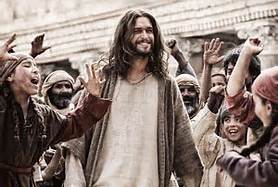
The casting of Diogo Morgado as Jesus caused many to complain about Morgado’s not being a Jew. But, it is simply not reasonable to expect directors to find actors of the same ethnicity for every role they cast. Moreover, Morgado was not the only ethnic discrepancy. Black African actors portrayed both the man who bore Jesus’s cross and one of the wise men from the East. Simon of Cyrene was most likely a Jew who had come to Jerusalem to celebrate the Passover, and the wise men from the east were probably Medes and Persians, present-day Kurds and Iranians.[2]

Morgado successfully conveys many of the characteristics of Jesus, such as compassion, love, and gentleness; but to such an extent that it takes away from Jesus’s authority, which the Bible says He spoke with when He taught. This especially affects the scene when Jesus overturns the money changers’ tables pic– probably the most pathetic scene of the entire movie. Jesus is portrayed heartbroken as he effortlessly turns over a few tables and weakly confronts the Pharisees before walking out of the Temple with His disciples. This plays into the hands of false teachers who claim Jesus was nothing more than a Jewish reformer who, disgusted with the corruption of the synagogues and Judaism of His day, broke away with His followers and formed another sect of the Jewish religion.
This is in stark contrast to what actually happened. Both Matthew and Mark record Jesus’s running the money changers out of the Temple, and Mark tells us He “would not suffer that any man should carry any vessel through the temple.” Whether He personally, physically threw them out and barred them from reentering, did so with the help of His disciples, or the money changers feared His thousands of followers is not given to us in Scripture and would certainly have been interesting to see played out in a director’s imagination. But a scene like that wouldn’t fit in too well with the nice-guy image of Jesus that the movie seeks to portray.

The lack of chronological accuracy is immediately observable to any viewer who has read the Gospels.

This included a couple of old ladies who were sitting in front of me in the theater, who during the duration of the film felt it would not be complete if they didn’t comment to one another during every scene on the inaccuracies of that particular sequence’s portrayal.

For starters, Simon Peter is alone when Jesus multiplies thie fish in Peter’s boat and when he calls him to be His disciple. Whereas in the Bible, (Mt. 4:18-20, Mark 1:16-18) Peter and his brother Andrew were together when Jesus called them. But assuming the film is basing the choosing of Peter off Luke’s depiction, in which Andrew is not mentioned (Luke 5:1-11), James and John are notably absent, and the movie makes it look as if Jesus was a complete stranger to Peter. In the Gospel of Luke, Jesus had already healed Simon’s mother-in-law in the previous chapter and was in Simon’s boat to begin with because He had been preaching from it.

Another example of shoddy chronology is when Jesus reads from Isaiah and tells those in the synagogue: “This day is this scripture fulfilled in your ears.” This scene appears toward the middle of the film, whereas in Luke, it happened before the miracle in Peter’s boat.

But it doesn’t end there. As Jesus and His disciples are being chased away from the synagogue, one of the Pharisees tells Jesus of John the Baptist’s death and warns that if He doesn’t watch it, he’ll be next. Since King Herod is completely removed from the movie, including during Jesus’ trial, they apparently had to come up with some way to explain John’s death. But making it look as if the Pharisees killed John is plainly irresponsible.

But it gets even more bizarre.

Jesus acts shocked and goes and sits sorrowfully under a tree with His disciples and then tells them “John was the greatest teacher I ever knew.” Presumably, this is supposed to be an offshot of Luke 7:24-28, which Jesus said about John while he was still alive.[3]

The movie is strewn with numerous little inaccuracies like these that make anyone with minimal Biblical knowledge cringe.

But before writing Son of God off as another Last Temptation of Christ or Jesus Christ Superstar, Christians should remember why the film was made to begin with and whom it was made for. Burnett and Downey admit the entire movie does not follow the Gospels accurately.  Burnett clarified that they’re not pastors and are not qualified to teach but are qualified to “make an emotional connection.” Like Jesus’s parables, Burnett said: “this film needs to stand alone so that those who had not read the gospels would be compelled to seek more.”[4]

All too often, movie-goers expect a two-hour movie based on a book that took them ten hours to read to accurately depict every sequence of the story exactly how they imagined it while reading. They then walk away from the cinema disappointed that the producers and director don’t have the same imagination they do. This is only amplified for Bible-based movies because unlike The Lord of the Rings or The Hunger Games, the events in the Bible not only happened, they deal with and were inspired by the Creator of the universe.

But, Son of God isn’t the Gospels on film. It’s an emotional tool intended to draw people to Christ. For instance, if a lost sinner understands the gospel message in church and becomes a follower of Christ, it’s of little consequence whether the preacher mentioned in his sermon that Pilate sent Jesus to Herod before having Him crucified.

Son of God is not another Passion of the Christ. It has neither the budget nor the renowned director and suffers from having to cram the entire Biblical story into one movie. But as an emotionthCAM3FCWPal tool to depict what Christ did for us, encourage believers to live as Christians, and urge non-believers to be learn more, the film succeeds.

While there are many chronological flaws and a few rings of false doctrine, such as Joseph and Mary’s acting surprised when the wise men bow down and worship Jesus, the basic message that “Christ Jesus came into the world to save sinners” and that He “is the Way, the Truth, and the Life” is amplified from the opening scene of St. John on the Isle of Patmos, to Jesus’s reappearing to Him on that same Isle after John has related Jesus’s life, death, and resurrection to the viewer.

This is definitely a movie that Christians should do their best to convince their unbelieving friends to see. Their friends will most likely walk away unconvinced and seemingly unmoved. Jesus was just a cool hippie, they’ll say, who was murdered by a bunch of religious zealots and Roman tyrants. But like Pilate’s memorable line in the film “He’ll be forgotten in a week” rings so untrue today, so too an unbeliever is not likely to be as uninterested in Jesus a week after viewing Son of God as he or she was a week before seeing it.


[1] Britt Gillette, “Jesus Of Nazareth (Movie Review),” ezinarticles, February 25, 2006, http://ezinearticles.com/?Jesus-Of-Nazareth-(Movie-Review)&id=152171.

[2] Christian Violatti, “Cyrene,” Ancient History Encyclopedia, December 30, 2010, http://www.ancient.eu.com/cyrene/

[4] Tyler, O’Neil, “Burnett and Downey Talk ‘Son of God’s’ Profound Impact: Address Critics on Biblical Inaccuracies,” The Christian Post, March 6, 2014, http://www.christianpost.com/news/burnett-and-downey-talk-son-of-gods-profound-impact-address-critics-115676/.