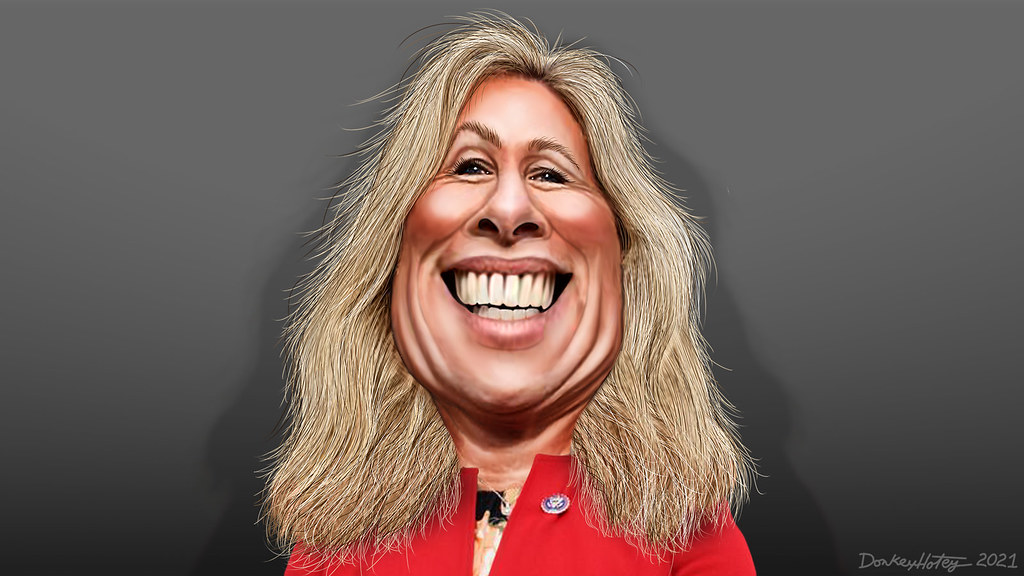
Good Riddance to MTG!

MTG’s self-serving political entrepreneurialism has run its course

In a bold move that reaffirms his unyielding commitment to crushing annoying ankle biters, President Trump has successfully sidelined Marjorie Taylor Greene, effectively running her out of Congress. On November 21, she officially resigned for Congress, announcing that January 5, 2026 will be her last day on the job her constituents elected her for.

This isn’t just a personnel change—it’s a cleansing of the Republican ranks from opportunistic pretenders who never had any business jumping into the political arena. Trump’s decisive action, leveraging his influence within the party to marginalize “MTG” marks a pivotal moment in cleansing Georgia’s Republican political delegation of a self-serving political influencer.

Although Trump is certainly no beacon of ideological consistency, he at least doesn’t pretend to be a purist or crusader for good government as Greene did. Trump is upfront about the sleaziness of government and openly admitted to paying off politicians on both sides of aisle when he ran for president in 2016. He never pretended draining the swamp was nothing more than removing the permanent bureaucracy with right-wing cronyism. Greene, on the other hand, is a businesswoman who pretended draining the swamp somehow meant restoring virtue to Congress, as if politics in any form has ever been virtuous.

This self-righteousness allowed her to build a following of naive ruralites, jealous of the politically connected and financially successful, all while she amassed eye-popping wealth after being in Congress, just like nearly every other Congressperson.

Greene represents the absolute worst of hillbilly culture—crude, confrontational, and devoid of substance. Her nastiness toward anyone she perceives as an opponent, from fellow Republicans to critics, turns political discourse into a backwoods brawl. She lashes out with venom, but it’s all bluster, amplified by her thick accent that gives a false impression of rugged conservatism. In reality, she’s not far-right in any meaningful way; her so-called radicalism is skin-deep, built on conspiracy theories that distract from real issues like trade policies harming her Georgia district. While she rode Trump’s coattails to fame, peddling wild tales for clicks and donations, she avoided tackling the economic pain caused by unchecked immigration and globalization.

Her discomfort with deporting non-violent illegal aliens is but one example of her faux right-wing radicalism. As an employer, she refused to implement E-Verify in her family business. This suggests she may have employed illegal aliens herself, prioritizing profits over protecting American jobs.

Another example is her seemingly inexplicable, diehard loyalty to moderate Kevin McCarthy during the Great 2023 Republican Speaker Battle, pitting herself against the actual diehard conservatives.

Greene had no business in Congress from the start. She should have stayed apolitical, perhaps sticking to her construction empire where her true loyalties lie—with exploitable labor and fat margins. Her conspiracy-minded rants, from QAnon flirtations to baseless claims, only embarrassed the party and alienated potential allies. Trump’s intervention, by rallying the base against her inconsistencies and pressuring party leaders, has finally shown her the door.

As we wave goodbye to this hillbilly hypocrite, America’s political landscape brightens. Under Trump’s guidance, Congress can refocus on real solutions—securing borders, boosting wages, and putting Americans first. MTG was someone who rocketed to MAGA stardom thanks to her larger-than-life personality, which she exploited for social media clicks and fundraising. But wielding political power is a marathon, not a sprint, and when Trump denied her entrance to the Senate by refusing to endorse her in the Georgia Senate race, it became obvious her head had hit the ceiling and there was nowhere else to climb on the political ladder but down. This explains her cozying up to the Left on CNN and The View.

Her exit is a win for right-wing politics, an art that demands cutthroat tribalism, not entrepreneurialism. True conservatism demands more than accents and attitude. Trump’s purge paves the way for a stronger, more unified front. The last thing his coalition needs is some loud mouth sophomore Congresswoman who thinks just because she can rile up poor souls to empty their meager bank accounts into campaign coffers it gives her a front seat at the party’s table.

Why Are Young Women So Liberal?

Image by Restoration News

What’s driving the massive gender split between America’s youngest voters?

The political gender gap among young Americans is widening at an alarming rate. If the Republican Party wants to avoid losing close, winnable elections, it must figure out why its message is repulsing young women and fix it.

In 2020, young voters supported Democrats at a similar wide margin as they did in 2008. But the real jolt came in 2024. Facing a historically inept candidate, amid a historically inept Democrat administration, President Donald Trump made understandable, large gains with Gen Z men. 

But Gen Z women barely budged. 

Men ages 18–29 made a 15-point swing to Trump. Young women, meanwhile, only moved eight points toward him. This turned young voters’ previous eight-point gender gap into a 15-point chasm. 

By contrast, the overall gender gap in 2024 shrunk to 10 points from 2020’s 11 points

Many blamed the young gender gap explosion on Trump’s appearances on male-centric podcasts in the online “manosphere.” But a newly released poll from the League of American Workers (LAW), coupled with last week’s elections, show 2024 was no fluke. 

In the LAW poll, Trump holds a 38-percent approval rate with men, ages 18–25, versus a 24 percent approval rate with young women. 

Democrats’ cataclysmic victories last week show this problem is getting worse for Republicans at the ballot box. Pollster Will Jordan aptly noted Democrats are “approaching Assad margins” with young women, referring to deposed Syrian dictator Bashar al-Assad’s past election wins.

Continue reading at Restoration News →

The Morality of Capitalism

Capitalism is good for everyone because it creates more crumbs.

Capitalism is ethical because human beings are flawed. In an imperfect world, it’s right and just for people to take what they can, when they can, and exploit materials, goods, and people to the best of their ability to take more.

Theft is unethical. Fraud is unethical. Aggression is unethical. Greed is not.

In fact, it’s the duty of every moral person to maximize their own profit to reach whatever their definition of happiness entails — even if that definition can never be satisfied.

Often, those who argue for government regulation or increased social welfare aren’t doing so from a pragmatic viewpoint. There are valid arguments to be made for things like public parks, public schools, and public infrastructure that a community can enjoy and share. But there is simply no reasoning with someone who thinks it’s morally wrong to become a billionaire.

Continue reading on Medium →

Elections Matter in Who Spends Where


One of the craziest things happened during the week after the election. My local bar was empty during a Vanderbilt home game.

On face value, that may not seem so strange. After all, Vandy is known as the redheaded—shall we say, blackhaired—stepchild of the Southeastern Conference. But this year is different because the Commodores are actually good. Nashvillians—native and transplant alike—have rooted in force for the ‘Dores after that glorious victory over the hated Alabama Crimson Tide that prompted the Vandy student section to baptize one of their goalposts in the Cumberland River.

Continue reading

Throwback to 1922 Midterm Elections


With the United States’ midterm elections in less than a month, I figured it calls for a Throwback Thursday post to revisit the midterms from a hundred years ago.

Agriculture, unionized labor, and debate over a World War I veterans bonus were the hot-button issues that defined the midterms in the 22nd year of the last century. But like every election, there were sleeper issues that played a role as well.

In 1922, the US was four years removed from World War I, three years removed from the Spanish Flu, and a year removed from one of the worst recessions in the country’s history. 

At the time, Senators had only been elected by popular vote in four election cycles thanks to the Seventeenth Amendment, which was ratified in 1913. 

The 1922 midterms were also only the second election when women in every state had the right to vote thanks to the Nineteenth Amendment, which was ratified in 1920. 

The State of the US Government in 1922

Entering the 1922 midterms, Republicans controlled the House, Senate, and White House. 

In the election of 1920, Republicans had picked up 67 seats in the House, raising their majority to a whopping 303–167, to this day, the largest majority their party has ever held in the lower chamber. 

Republicans also picked up ten seats in the Senate, bringing them to a 59–37 majority in the upper chamber. 

President Warren Harding won the White House in 1920 with more than 60 percent of the popular vote after two terms of Democrat President Woodrow Wilson. Harding ran on a platform of restoring America to its pre-war prosperity and normalcy. 

Democratic leadership, meanwhile, continued to advocate for American meddling on the international stage — a message that proved hugely unpopular with voters after the war.

Continue reading…