The convergence of economic factors and viral journalism often drives migration trends.
The United States has always been one of the hottest destinations for immigrants searching for a better life. What’s not discussed as much is when Americans themselves move elsewhere in search of a better life.
When people think of emigration out of the United States, they probably think of middle-class or affluent Americans moving to Singapore, Australia, Canada, or the United Kingdom for business. Perhaps, EU countries also come to mind.
But in 2015, Ecuador topped the list of nations Americans moved to, according to the Association of American Residents Overseas (AARO). In fact, Americans made up more than half of Ecuador’s immigrant population at the time.
An Expat Insider survey found that 86 percent of immigrants in Ecuador were satisfied with their choice to live there.
It’s no wonder that Edward Snowden chose this country as his desired asylum destination.
Ecuador is still considered a developing country by the UN and World Bank. But it’s one of the better-off nations in that category, which makes its cost of living better than America’s while offering enough modern conveniences and safety to make it attractive.
Like it or love it — hating it isn’t an option — flex culture is in. And it’s not going away for at least a generation.
So, rather than complain about the culture like a bunch of old fogies, a better approach is to embrace it. After all, we can agree that alcohol and marijuana prohibition didn’t work. Regulation is a much better option.
So, what is flex culture?
Flex culture is a social media-driven phenomenon “of deliberately showing yourself off about your personal belongings in the goal of giving yourself higher value in front of other people.”
For kids with wealthy parents, it can be fun. For middle-class college students and young professionals, it can become addicting and life-ruining.
However, most people will never become minimalists or engage in monkish self-denial. So, rather than encourage you to become counter-cultural, here are three things not to buy to flex on peers.
Good Vibes Only May Mean Your Friends And Family Don’t Care To Critique Your Work
One of the aspects of passive listening is constant agreement.
You know–endless nodding, smiling, lack of meaningful input.
That’s when you know it’s time to change the subject or–better yet–just stop talking. The person you’re talking to clearly isn’t hearing you.
This happens often whenever people present their work to friends and family–and makes presenting one’s work to friends and family a problem in itself.
In our culture of toxic positivity, no one wants to be the one to rain on your parade. Most people who love or respect you think it’s great you’re venturing out and doing work outside your 9–5 and are probably not going to tell you what they really think about that work.
The “everything is awesome” culture will win most of the time.
Some people will be honest and tell you if what you wrote stinks–people who respect your potential more than your feelings. But most people are so used to others’ wearing their feelings on their sleeves that they’re loath to provide negative feedback.
Ever get the feeling you’re just happier during autumn?
You’re not alone.
According to a survey of 2,000 Americans, 56 percent said they were happier in autumn than any other time of year — and this was conducted in the middle of the pandemic.
At surface level, it seems counterintuitive. How does autumn compete with spring or summer?
It’s cold — often rainy — and it reminds us that winter is coming. We have to go back to boring school or our boring jobs after a much-needed vacation. Also, because of the holidays and traveling, money is often tight.
There are upsides, for sure.
The cool, crisp air; the food and drinks; in America and Canada, Thanksgiving — also in America and Canada, football and hockey seasons.
Traditional autumn fashion is also better than the stuff people wear at other times of the year.
Then, there are the leaves.
Growing up in Florida, that didn’t mean much. Leaves turned from bright green in September to a boring brown by November.
Just as some entrepreneurs form partnerships, some bloggers like to combine their efforts.
Two is better than one, right? If friends want to blog about the same or a similar topic, why not join forces and reach their goals twice as fast?
They each bring their own friends and social media followers — potentially doubling initial readership. They both write posts, so they produce twice as much content and drive traffic twice as fast.
This sounds good. But two people working on a project doesn’t automatically translate to ‘twice as fast’.
If one has a steep learning curve, he can slow down his partner.
Maybe one has a strong ego that would help him succeed solo but prevents him from matching that success in a partnership.
Finally, some partners simply haven’t learned the Law of Comparative Advantage and mismatch each other’s skills.
These are serious conversations that blogging partners should have before discussing blog names, WordPress themes, or social media accounts.
Here are three specific things to keep in mind before buying that domain name with someone else.
Queen Elizabeth II’s death renewed interest in the British royal family internationally. Outreigning Queen Victoria by seven years, she was the longest-reigning monarch in British history. She represented stability in the UK following the British Empire’s weakening after World War II.
Something I learned from my personal increased interest is that the British Royals aren’t originally Windsors. In fact, they aren’t even originally British.
So, why did this non-British British royal family take the name Windsor?
German Roots
The German Duke Ernst Anton of Saxe-Coburg-Saalfeld became the first duke of Saxe-Coburg—or Ernst I—in 1826. His sister—Princess Victoria of Saxe-Coburg-Saalfeld—was the mother of Britain’s Queen Victoria. Ernst’s second son, Prince Albert of Saxe-Coburg, married his cousin Victoria in 1840.
Victoria herself was of 100 percent German stock. Her father was Prince Edward—King George III’s fourth son—of the House of Hanover.
It was not uncommon for German royalty to marry into other royal families and rule over other countries.
In fact, the three principal monarchs of World War I: Kaiser Wilhelm II of Germany, King George V of Great Britain, and Tsar Nicholas II of Russia, were cousins and descended from King George II of Britain.
Ethnic German monarchs in 1914 included Albert I (Belgium), Wilhelm of Wied (Albania), Ferdinand I (Bulgaria), Karl I (Romania).
Just as children take their father’s last name, monarchs took the name of the house of their father—which meant taking the name of the land their father’s family ruled.
King Edward VII, Victoria’s eldest son, thus, became the first monarch of the House of Saxe-Coburg-Gothe—a much more in-your-face German-sounding name than the House of Hanover.
Last week, my friends Steven and Wesley and I explored the abandoned Carroway Hospital in Birmingham. With limited “urbexing” experience, I was a bit hesitant to go, considering Steven wanted us to camp atop the roof.
The pictures he showed me of the view, however, made it seem worth it. I don’t mind exploring abandoned places—even alleged haunted ones—provided I’m with other people. Besides, I’ve always had a penchant for getting away with harmless mischief.
About Carraway Hospital
Dr. Charles Carraway started a 16-bed hospital in his town of Pratt City, AL, in 1908. In 1917, he bought the current location on the corner of 16th Ave and 25th St in Birmingham and relocated it. He named it Norwood Hospital after the neighborhood. The hospital later changed its name to Carraway Methodist Hospital.
Dr. Carraway suffered a stroke in 1957 and turned it over to his son Ben, who greatly expanded capacity. The iconic star atop the roof, which used to be blue, was added on Christmas Day, 1958.
Dr. Carraway died in 1963, but his legacy continued as one of the most state-of-the-art hospitals in Alabama. The neighborhood surrounding it, however, declined greatly in the 70s and 80s, even as the hospital put tens of millions of dollars into expansion.
By the early 2000s, finances caught up with it. In 2006, Carraway filed for Chapter 11 bankruptcy, and a year later, it was auctioned to Physicians Medical, LLC. The new owners briefly turned it around. But by the fall of 2008, they couldn’t make payroll and closed it.
The women’s rehab charity The Lovelady Center bought it in 2011 for $6 million. However, local residents opposed a rehab center in their neighborhood. After a local zoning board failed to approve it, The Lovelady Center sold it to a development group in 2018. The new owners plan to turn it into a mixed-use development.
With the hospital’s imminent demolition and transformation in mind, we knew we had limited time to explore it. In fact, the new owners had told Steven over the phone early this year they would start tearing it down in May.
Exploring Carraway’s Ruins
I got to bed late the night before and ended up sleeping till the last minute. So, I didn’t have time to get any coffee. I figured there would be somewhere to stop, or at least a convenience store close to the hospital.
Steven—who was driving,—takes caffeine pills, however. So he pulled over at a Dollar General on the way to pop a couple. I went inside to get a Monster but found none of them were cold.
Much to my disappointment, the neighborhood surrounding Carraway is an urban wasteland as far as quick food or coffee goes. There is one Kentucky Fried Chicken about half a mile away, but otherwise, even crummy gas stations seem few and far between.
We stopped at the KFC, and I got a Mountain Dew. I hate soda, but I needed the caffeine.
We parked across the street from Carraway at a government-housing parking lot.
After all, if you’re going to trespass, go all out!
We left our gear in the car and entered through the front entrance.
“That’s where we’ll sleep,” Steven said, pointing to the building next door.
The complex is huge. I don’t know why I expected it to be any smaller than modern hospitals, considering it just closed down 14 years ago.
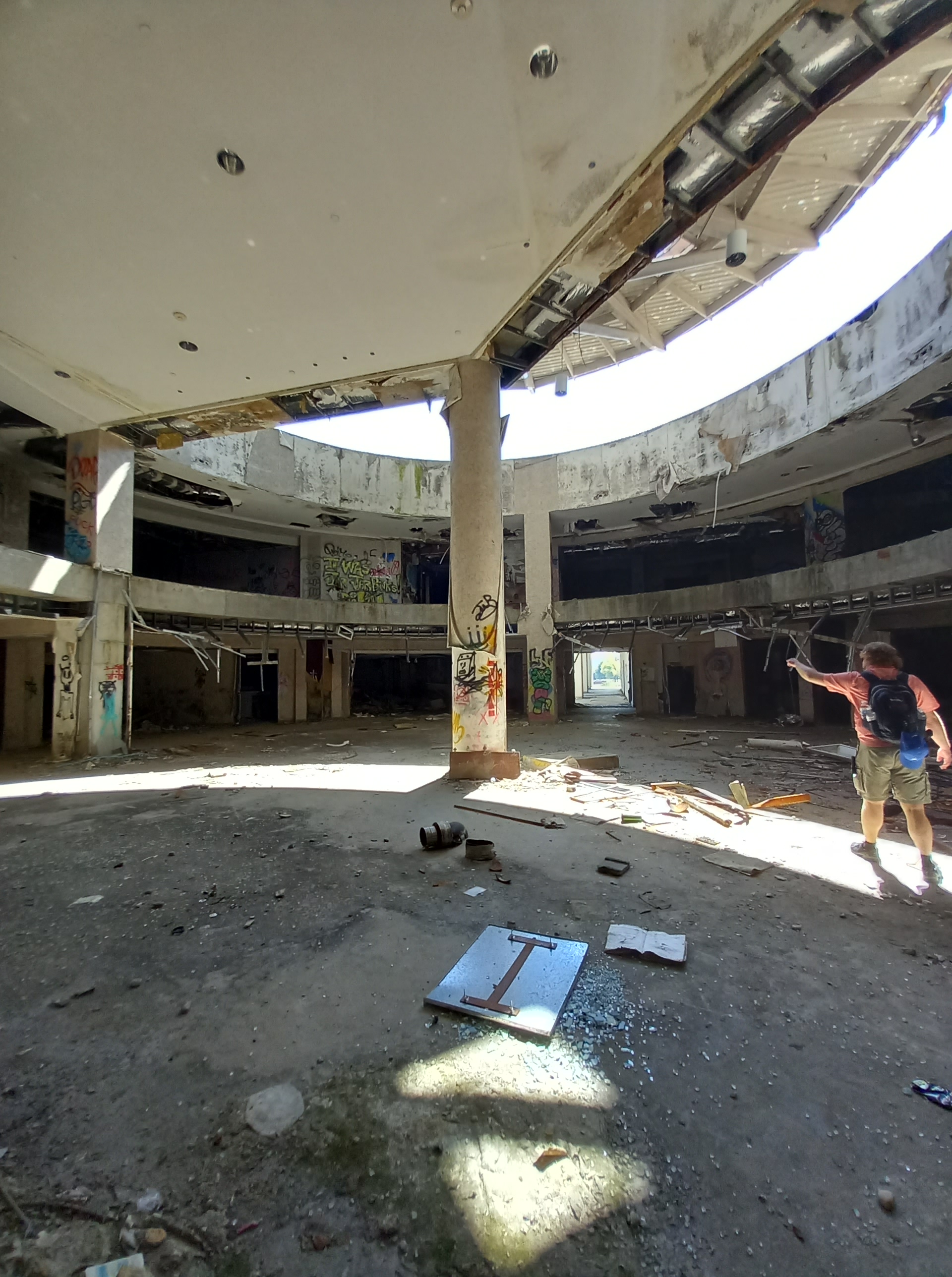
Entering Carraway felt like entering a set for The Walking Dead. Vandals had smashed every window in sight and stripped every wire.
Although our flashlights were strong, once we entered the main floor, it was like the darkness enveloped us. In some parts—in broad daylight—seeing six feet ahead would be impossible without a light.
Steven knew what each building used to be and acted as our tour guide. I wasn’t as interested in the history of the buildings and rooms as I was climbing to the top floors for the views.
The hall on the first floor led to an open courtyard. We went into what used to be an auditorium before climbing the stairs to the roof.
To get to the roof, we had to climb through a shattered window, then walk across about 20 feet of glass. Steven and I went across, but Wesley stayed behind. I thought he was afraid of the glass, but as I found out later, it was the height.
The view from the rooftop made the risk of glass going through my Nikes worth it. In the distance, I could see what looked like an EMS station with a few cars parked inside its carport. Nearby, I heard construction workers, probably the same ones we’d seen behind the complex when we drove around it earlier.
On my way back inside, I found wading across glass the second time a bit more stressful.
After leaving the courtyard, we made our way toward the back of the main building, stopping along the way to check out various rooms. The intact curtains and undisturbed ceilings made this section feel eery after seeing other sections gutted of nearly all but concrete.
We went to the back stairwell, passing the elevator shafts. Being a thriller fan, my mind went to different scenes these shafts could be used for. I admit I winced slightly every time I looked down, not knowing what I might see.
The Star Spangled Banner is not representative of the totality of the American nation and should not be its national anthem.
Don’t get me wrong. It’s a great patriotic song, and it poeticizes a great feat in American military history. It would make for a great military anthem. National anthems, however, should reflect the nation’s identity — its natural beauty, culture, history, traditions, and hopes — not just its military exploits.
Take these lines from the Canadian national anthem, for instance:
O Canada! Where pines and maples grow, Great prairies spread and lordly rivers flow, How dear to us thy broad domain, From East to Western sea! Thou land of hope for all who toil! Thou True North, strong and free!
Or the New Zealander national anthem.
God of Nations at Thy feet, In the bonds of love we meet, Hear our voices, we entreat, God defend our free land. Guard Pacific’s triple star From the shafts of strife and war, Make her praises heard afar, God defend New Zealand.
Or this from the Australian national anthem:
We’ve golden soil and wealth for toil, Our home is girt by sea; Our land abounds in nature’s gifts Of beauty rich and rare; In history’s page, let every stage Advance Australia fair.
Each of these — like many other anthems — touches on the geographic features of the nation. Mountains. Soil. Oceans. Geolocation. They often mention attributes or values of the people.
National anthems often mention past military sacrifice but stay grounded in the present — or at least the ideal of a harmonious present in an idyllic landscape. In other words, the battle and ensuing sacrifice for victory is not the end in itself. That would suggest a nation at perpetual war. Is that really the image people want to project of their country?
Besides the singular focus on wartime and the visual image of battle, The Star Spangled Banner is difficult to sing. The raucous applause artists receive after performing it at ballgames owes as much to their hitting the high notes as a display of patriotism.
With the United States’ midterm elections in less than a month, I figured it calls for a Throwback Thursday post to revisit the midterms from a hundred years ago.
Agriculture, unionized labor, and debate over a World War I veterans bonus were the hot-button issues that defined the midterms in the 22nd year of the last century. But like every election, there were sleeper issues that played a role as well.
In 1922, the US was four years removed from World War I, three years removed from the Spanish Flu, and a year removed from one of the worst recessions in the country’s history.
At the time, Senators had only been elected by popular vote in four election cycles thanks to the Seventeenth Amendment, which was ratified in 1913.
The 1922 midterms were also only the second election when women in every state had the right to vote thanks to the Nineteenth Amendment, which was ratified in 1920.
The State of the US Government in 1922
Entering the 1922 midterms, Republicans controlled the House, Senate, and White House.
In the election of 1920, Republicans had picked up 67 seats in the House, raising their majority to a whopping 303–167, to this day, the largest majority their party has ever held in the lower chamber.
Republicans also picked up ten seats in the Senate, bringing them to a 59–37 majority in the upper chamber.
President Warren Harding won the White House in 1920 with more than 60 percent of the popular vote after two terms of Democrat President Woodrow Wilson. Harding ran on a platform of restoring America to its pre-war prosperity and normalcy.
Democratic leadership, meanwhile, continued to advocate for American meddling on the international stage — a message that proved hugely unpopular with voters after the war.
I’m not talking about people who are genuinely affected by celiac disease or who suffer from gluten sensitivity. They obviously have to eat gluten-free.
For over a decade, however, going gluten-free has become a fad to signal the virtue of self-care.
According to the Celiac Disease Foundation, celiac disease diagnoses have increased an average of 7.5 percent over the past few decades. But even this remains minuscule. A study in Minnesota found that from 2000 to 2010, those with celiac disease increased from 11 for every 100,000 to 17 for every 100,000.
Genetics can cause celiac disease but so can environmental factors. I have a family member who developed it from the stress she experienced in college.
But the explosion in gluten-free food doesn’t account for the small growth in gluten-related illnesses.
From 2004 to 2011, gluten-free products increased at an annual rate of 28 percent.
In 2013, in its ‘Healthy Eating Consumer Report’, Technomic found that, in 2010, gluten-free items on limited-service restaurant menus were virtually non-existent. By 2012, there were hundreds. In fact, by the early 2010s, many restaurants were treating gluten-free as a healthy food choice rather than a way to attract celiac customers.
Soon, the public became bombarded with gluten-free Girl Scout cookies, Vodka, and even Trader Joe’s satirical “Gluten-Free Greeting Cards.”
Figuring out which came first, the supply or the demand, requires further research. What’s certain, though, is that they overlapped. The percentage of households purchasing gluten-free products increased from 5 to 11 percent from 2010 to 2013.
Virginia Morris, vice president for consumer strategy and insights at Daymon Worldwide, a private brand and consumer interactions company, told the New York Times, “There are truly people out there who need gluten-free foods for health reasons, but they are not the majority of consumers who are driving this market.”
Indeed, less than one percent of the population suffers from celiac disease. Only six percent suffers from mild gluten-related symptoms. This made the five percent of gluten-free consumption in 2010 in line with the percentage of people who actually needed it.










 Jacob Grandstaff